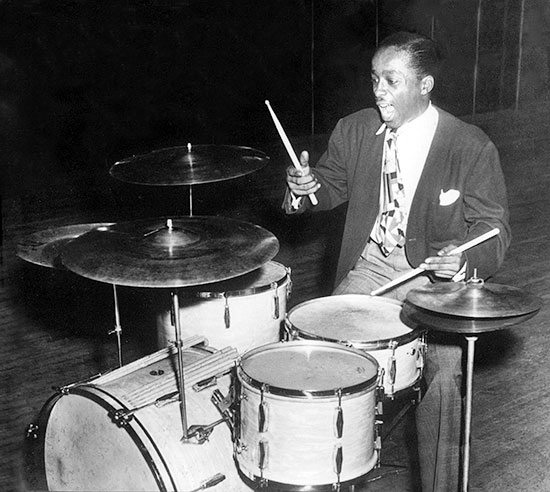
Lest We Forget: Sonny Payne
By Alex Henderson
A passionate and hard-swinging drummer, Percival “Sonny” Payne is best remembered for his years with the big bands of pianist Count Basie and trumpeter Harry James. Though Payne, born in New York City on May 4th, 1926, was the same age as many bebop and cool jazz musicians, swing was his primary focus. Payne had a jazz-friendly upbringing: his father Chris Columbus, a.k.a. Crazy Chris Columbo (Jun. 17th, 1902—Aug, 20th, 2002) was also a drummer and associated with Wild Bill Davis.
The native New Yorker was in his teens when he studied with drummer Vic Berton, and he developed a reputation as a swing musician thanks to his work as a sideman for trumpeter Hot Lips Page, guitarist Tiny Grimes and alto saxophonist Earl Bostic in the ‘40s. Payne also played in the band that tenor saxophonist Paul Bascomb and his brother, trumpeter Wilbur “Dud” Bascomb, co-led during that period.
After Payne’s stint with trumpeter Erskine Hawkins’ orchestra from 1950-53, he joined the Basie orchestra in 1954 and was featured on a long list of Basie albums in the ‘50s-60s, including sessions for Verve and Roulette. Payne worked with traditional pop icon Frank Sinatra when, in the ‘60s, the singer joined forces with Basie’s orchestra (Payne appeared on the 1962 date Sinatra-Basie: An Historic Musical First, which featured arrangements by Neal Hefti). Payne played alongside a stellar cast of instrumentalists in the Basie band, including trumpeters Snooky Young, Thad Jones and Joe Newman, tenor saxophonists Frank Foster and Frank Wess, alto saxophonist/clarinetist Marshal Royal, baritone saxophonist Charlie Fowlkes, trombonists Benny Powell and Al Grey, guitarist Freddie Green and bassist Buddy Catlett. And Basie’s orchestra also united him with top-notch vocalists such as Joe Williams and Jimmy Rushing.
Payne occasionally dabbled in bop or cool in the ‘50s-60s, appearing on albums by singers Ella Fitzgerald, Sarah Vaughan and Chris Connor and joining pianist Bud Powell (the quintessential bop pianist) at New York City’s Birdland in 1953. And Payne even ventured into early rock ‘n’ roll when he appeared on some Chuck Berry sessions for Chess Records. Payne also embraced rock ‘n’ roll material on Basie’s Beatle Bag, Count’s unlikely yet thoroughly enjoyable 1966 tribute to The Fab Four.
After parting company with Basie in 1966, Payne played in James’ band extensively in the late ‘60s-70s. He regrettably never recorded an album as a leader, although he did lead his own trio briefly around 1966 before being hired by James, a major admirer of Basie who was delighted to have Payne as a sideman. The ‘70s found Payne reuniting with Basie in 1973-74 and touring Europe with tenor saxophonist Illinois Jacquet in addition to his work with James during that period. Sadly, Payne was only 52 when he died of pneumonia in Los Angeles on Jan. 29th, 1979 (James generously paid all of his hospital bills as well as his funeral expenses).
A tribute to Count Basie and Duke Ellington’s The Count Meets the Duke, by Wynton Marsalis, Vincent Gardner and Rodney Whitaker is at Rose Theater May 19th-20th. See Calendar.
Recommended Listening:
• Count Basie Orchestra—The Complete Atomic Basie (Roulette, 1957)
• Lambert, Hendricks & Ross—Sing a Song of Basie (Impulse!, 1957)
• Ray Charles—Genius + Soul = Jazz (Impulse, 1960)
• Duke Ellington and Count Basie Orchestras—First Time! (The Count Meets the Duke) (Columbia, 1961)
• Count Basie—And the Kansas City 7 (Impulse, 1962)
• Harry James—Live in London (Sounds Great/Jasmine, 1971)